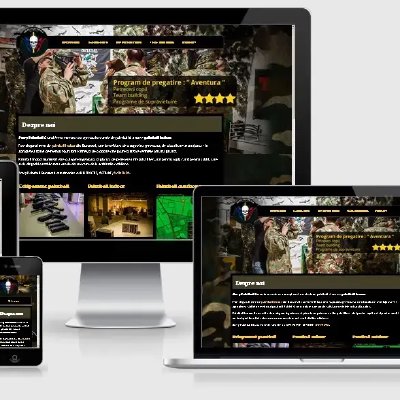
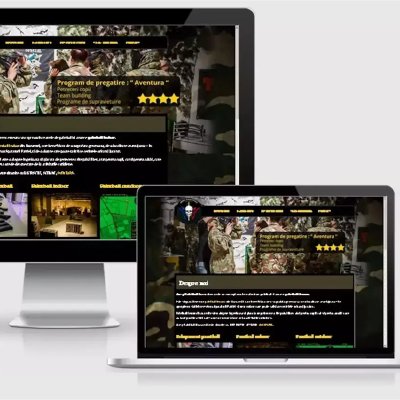
About the Army Paintball Project
Army Paintball needed a website that sold an hour of playtime, not just a digital brochure. It required three clear entry points: games for adults, children’s parties, and groups (corporate events, team building).
In 2014, we built the site using Drupal 7, featuring a custom visual identity, a page structure based on user intent, and copy tailored to the search terms used by local customers.
The site remained the venue’s primary online reference for over a decade. This serves as a practical case study for hotel, restaurant, or agency owners: an architecture that kept the offer, pricing, and booking system in one place, consistently generating leads from Google year after year.
Web Design & Web Development
This wasn’t just a standard brochure site with a few paragraphs of text. It was a product with specific rules: pricing based on paintballs rather than time; party packages including a dedicated room, duration, and paintball count; distinct explanations for indoor versus outdoor fields; and corporate groups requiring different logistics compared to a 10th birthday party.
Drupal 7 was the right choice at the time: it handled extensive content, offer-specific pages, fluctuating rates, image galleries, and text that the team needed to update seasonally without developer assistance.
Key structural elements included:
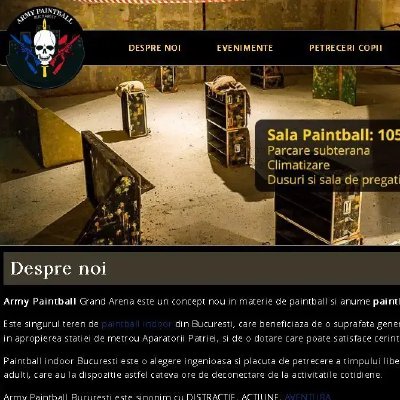
- A landing page for the venue and “paintball Bucharest” searches, featuring field details, the address, and directions (city center, Eroilor metro station).
- A dedicated page for children’s parties: age requirements, duration, package inclusions, and room capacity. Parents didn’t need to read the full game rules just to book a birthday party. - Rates extracted from marketing copy and presented in tables. The per-session price and the fixed package for small groups are the key factors driving the purchase decision.
- Dedicated sections for indoor activities, equipment, and—at a later stage—team building. Same underlying framework, yet distinct content types.
- Booking form or call-to-action directly on the offer pages, rather than buried in the footer.
Drupal 7 is no longer a viable stack for new deployments today; official support ended in January 2025. For a similar venue today, I would stick to the same content model—offer types, rates, booking—but implement it on WordPress if the team needs to edit content frequently, or on a modern version of Drupal if the site structure and permission requirements justify it. A sports facility or hotel with an outdated Drupal 7 site requires mandatory migration and maintenance.


Logo Design
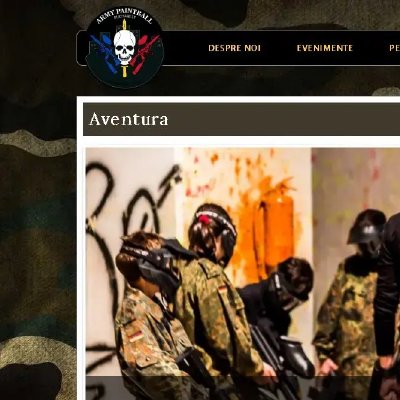
The brand had an inherent tension. The name and the nature of the activity call for a military aesthetic—stencils and high contrast. The second requirement—appealing to parents—demands that they not feel like they are sending their child to a military training ground.
The identity managed to balance both without clashing:
- A concise graphic mark, legible at small sizes (favicons, headers, gear) and against dark backgrounds. The graphics evoke an “army” feel.
- A dark color palette with an accent color that remains visible on a phone screen in direct sunlight—whether at the outdoor field, the indoor arena, or the training hall. No generic agency gradients or stock photos of smiling soldiers.
- Two distinct visual registers rather than just one: the field and gear for the player; the indoor arena, group setting, and instruction for the parent. Same brand, different context.
- A logo used as a system rather than just a static header image: simple rules regarding spacing and backgrounds ensure it doesn’t fall apart when applied to price lists, invitations, or photos of the playing field.
The lesson is the same for a hotel, restaurant, or event planner. A brand doesn’t just decorate a website; within five seconds, it communicates exactly who you are targeting—and who you aren’t. If you sell hotel rooms, group meals, and events, you don’t cram them all into the same visual frame.


Marketing
Marketing here wasn’t about a brand campaign; it was about the user journey leading to a booking.
Three intentions, three paths:
- I want to play – the court, indoor/outdoor, gear included in the price, address. No birthday package on the initial screen.
- I’m hosting a party – duration, venue, number of kids, inclusions, group pricing. Pizza and soda are details, not the core promise.
- I’m bringing my company – team building, off-site logistics, the fact that the venue hosts the game itself. Different decision-maker, different copy.
What I used on the page—and what remains relevant for the hospitality industry:
- Offer first, story second. Price and inclusions beat a paragraph about adrenaline.
- Concrete location details: street, district, travel time to the nearest metro station. Nobody books based on a vague “in Bucharest.”
- Tiered packages (up to 10 people vs. over 10) instead of “starting at” pricing. Restaurant owners know why: a table of 8 and an event for 40 are not the same product.
- Group social proof on the corporate page (team-building clients), not the kids’ page. You don’t mix corporate testimonials with birthday party ones.
I don’t market this page as a “social media” or advertising case study. Back in 2014, the focus was on the website and search visibility. Paid promotion and social media accounts are separate services with monthly budgets; I link them to the relevant pages—I don’t retroactively invent them as part of a website project. —
SEO
In 2014, the client’s site targeted three specific terms: paintball Bucharest, paintball, and kids’ party. This made sense for the business; the client is looking for the specific location and services they want to book.
Here is how these were covered without overlapping or conflicting:
- A dedicated title and page for the location (“Paintball Bucharest”), featuring the actual address and field details, rather than just a keyword repeated in the footer.
- A separate page for kids’ parties, with its own title. Same brand root, different intent. Otherwise, “paintball” and “party” would compete for the same URL.
- The short-tail term “paintball” remains on the homepage and game pages, not on the birthday pricing pages.
- Useful on-page content: what the price includes, how paintballs are billed, and the age group for the party. No filler paragraphs stuffed with synonyms.
This is a concept that a hotel or restaurant owner can easily relate to. For them, the equivalent isn’t “paintball Bucharest.” It’s “restaurant [city],” “hotel [area],” or “event venue [city],” plus a secondary intent (table reservation, room booking, party, team building) hosted on a separate URL.
What still holds true / What I would do today
What holds true: one intent = one page; visible pricing; the venue listed as an address rather than a slogan; maintaining strong branding when the offer targets two distinct audiences. Today, for a venue in this sector (hotel, event-hosting restaurant, travel agency, or event space):
- A presentation website with booking or inquiry capabilities—starting with the Professional package—if your team handles the content updates.
- A brand identity overhaul—only if the current brand fails to appeal to both target audiences (this is an add-on, not included by default).
- Local SEO post-launch, targeting specific cities and booking types rather than generic industry terms.
- If the current site runs on Drupal 7 or an outdated WordPress version (e.g., from 2016): migration followed by a maintenance plan. Not a redesign built on top of an unsupported installation.
If you run a venue and your website isn’t generating bookings, let me know what you offer and in which city. I’ll tell you whether it needs a rebuild, a migration, or simply some fine-tuning of the pages that drive sales.